
Most tube "failures" are the tube reporting a problem elsewhere in the mould. Before ordering a replacement, it pays to read the old tube: the pattern of wear, cracking or distortion usually points at the cause. Here are the seven defects we see most, what causes them, and what to check.
Where: thermal cracks in the chrome, or copper cracks, in a band 50–150 mm below the top of the tube, i.e. around the meniscus. Cause: thermal cycling; the meniscus is where the copper temperature swings most with every level fluctuation and every stop. Aggravated by unstable mould level, frequent restarts, and Cu-DHP on a fast caster. Symptom on the billet: transverse surface cracks, copper pick-up on reheating. Check: mould level control, casting speed against the tube's design speed, copper grade.
Where: exit end, especially the corners; measured exit section grown. Cause: normal abrasion by the shell and mould powder; accelerated by over-taper at the exit, misalignment between mould and foot rolls, and abrasive powders. Symptom: billet section drifts, rhomboidity, more breakouts as the taper opens. Check: alignment of the mould to the first segment, oscillation stroke, lower taper value.
Where: one face bulged outward or the bore gone rhomboid, sometimes a change in the casting radius. Cause: overheating of one face (uneven cooling), ferrostatic pressure on a softened wall, or a breakout that froze against the copper. Symptom: rhomboid billets that follow the tube's shape, cannot be corrected by taper. Check: water gap uniformity, jacket baffle wear, tube centring, cooling water flow. A deformed tube is not repairable.
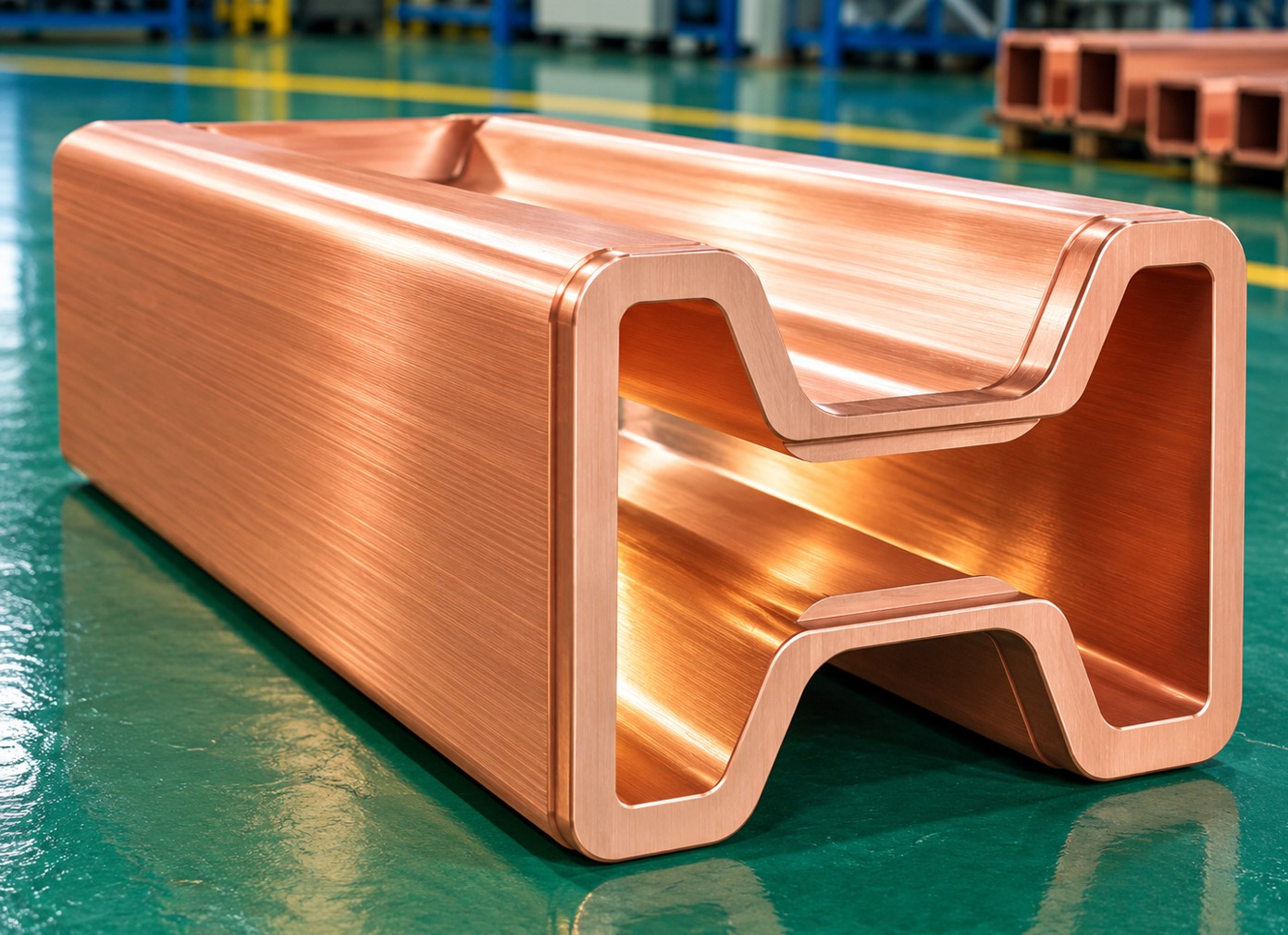
Where: the tube measures fine but the billets are wrong: rhomboid, off-corner cracks, sticker breakouts. Cause: a taper designed for one speed used at another; a "standard" taper on a caster that needs a specific one; or a re-plated tube whose taper was not restored. Symptom: under-taper gives thin, uneven shells and breakouts; over-taper gives corner cracks, deep oscillation marks and fast corner wear. Check: the CMM report against the OEM profile; casting speed history.
Where: flaking near the meniscus, scoring down the length, worn through at the exit. Cause: flaking from poor adhesion or copper softening beneath; scoring from a sticker or trapped scale; wear-through from a chrome layer too thin for the campaign. Symptom: copper pick-up, star cracks on the billet, longitudinal surface marks. Check: plating specification and certificate; mould powder consumption; campaign length versus chrome thickness.
Where: scale on the outside of the tube, discoloured (blue / black) copper, uneven wear around the perimeter. Cause: hard or dirty water, low flow, air in the jacket, worn baffle. Symptom: everything else on this list, plus short tube life. Check: water quality report, flow and pressure at the mould, jacket condition.
Where: the whole tube has softened: hardness below specification, taper opened uniformly, bore grown everywhere. Cause: running Cu-DHP at CuAg speeds, cooling water above 40 °C, low velocity. Symptom: tube life a fraction of expected with no single visible fault. Check: copper grade against casting speed; upgrade to CuAg or CuCrZr.
Check the mould dimensions (jacket, baffle, flanges), the cooling system (flow, pressure, water quality), and the operating conditions (speed, level control, alignment, oscillation). If the tube is a repair candidate, send it in; if it is not, send us photos anyway, because the failure pattern tells us what taper and grade the replacement should have.
Measure the water gap around the tube in the jacket, and the taper on a CMM. Rhomboidity is nearly always cooling or taper, not the tube material.
Usually well enough to say whether it is cooling, taper or wear. Photos of the bore at meniscus and exit, and of the outside of the tube, are what we need.
For larger projects we can arrange a visit; for most cases photos and the old tube are enough.
Related pages: Tube life · Repair and re-plating · Taper explained · Water cooling · Copper Mould Tubes