
The line between billet and bloom is not sharply defined; most people call sections up to about 160 mm square billets and larger squares and rectangles blooms. The tubes for both are made the same way, but almost every parameter shifts as the section grows, and at some point a one-piece tube stops being the right mould at all.
| Item | Billet | Bloom |
|---|---|---|
| Section | Smaller: 70 × 70 to ~160 × 160 mm, Ø90–Ø160 | Larger: 165 × 165 to 200 × 200 and up, rectangular to 150 × 520, Ø180–Ø500 |
| Mould design | Billet tube, one piece | Bloom tube, one piece up to a limit; plate moulds beyond |
| Wall thickness | 8–12 mm | 12–20 mm and more |
| Casting radius | R4–R9 typical | R9–R15 typical |
| Casting speed | Higher: 2–4.5 m/min | Lower: 0.6–1.5 m/min |
| Cooling | Application dependent; often annular gap | Application dependent; often slot-cooled or drilled |
| Copper grade | Cu-DHP / CuAg / CuCrZr | CuAg / CuCrZr predominantly |
| Taper | Customized; steeper, double or parabolic | Customized; often multi-taper, corner-specific |
| Length | 700–1000 mm | 800–1000 mm |
Ferrostatic pressure is the same at a given depth regardless of section, but the unsupported width of each face grows with the section, so the bending load on the copper wall grows with it. A 200 × 285 bloom tube at 12 mm would bulge; 16–20 mm is normal. The thicker wall raises the hot-face temperature, which is one reason bloom tubes are almost always CuAg or CuCrZr.
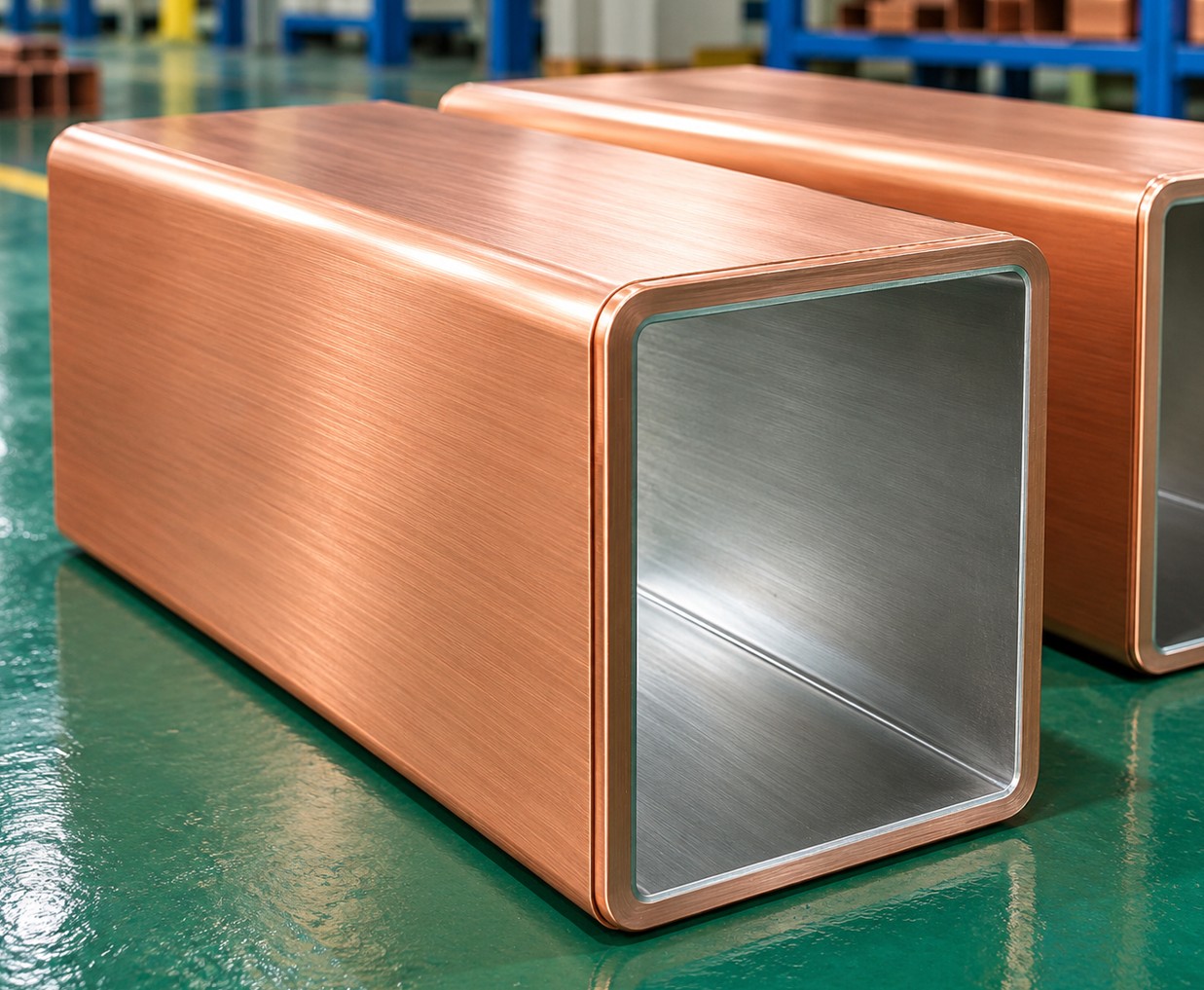
A larger section needs a thicker shell at the mould exit to hold the liquid core, and shell thickness grows with time in the mould, so bloom casters run slower. Lower speed means lower heat flux per unit area but a longer residence time, and the taper is calculated differently: the total shrinkage inside the mould is larger, the profile flatter at the top and often corner-specific to control the thick shell in the corners.
Billet tubes are commonly cooled in a plain annular gap. Bloom tubes more often have machined longitudinal slots or drilled cooling channels, because the thicker wall and lower speed make it harder to keep the copper temperature even with a simple gap. The jacket design follows the tube; see water jackets.
Above roughly 200 × 300 mm, or for rectangular sections with a high aspect ratio, a one-piece copper tube becomes impractical: the copper blank is huge, the bore cannot be machined accurately over the length, and thermal distortion is uncontrollable. Bloom and slab casters at that size use four-plate moulds with copper plates on a steel back-up. We supply copper mould plates in CuAg and CuCrZr to drawing for those casters; the tube pages on this site cover sections up to 150 × 520 mm rectangular and Ø500 round.
For billet tubes, the standard sizes and the questions in our buyer's guide apply. For bloom tubes, expect every order to be to drawing, expect CuAg or CuCrZr, and expect the cooling design and the water jacket to be part of the conversation. Material selection is not an absolute rule in either case: a slow bloom caster can run Cu-DHP, a fast billet caster may need CuCrZr.
Yes, Ø180 to Ø500 mm, R6000–R15000; see the round section table.
Sections such as 150 × 200 or 160 × 220 are treated as blooms for wall and grade, billets for speed; send the drawing and we advise.
Yes, CuAg and CuCrZr plates with cooling slots to drawing, including Ni-Cr coating.
Related pages: Specification tables · Copper Mould Tubes · Copper materials · Mould water jacket · Request a quote