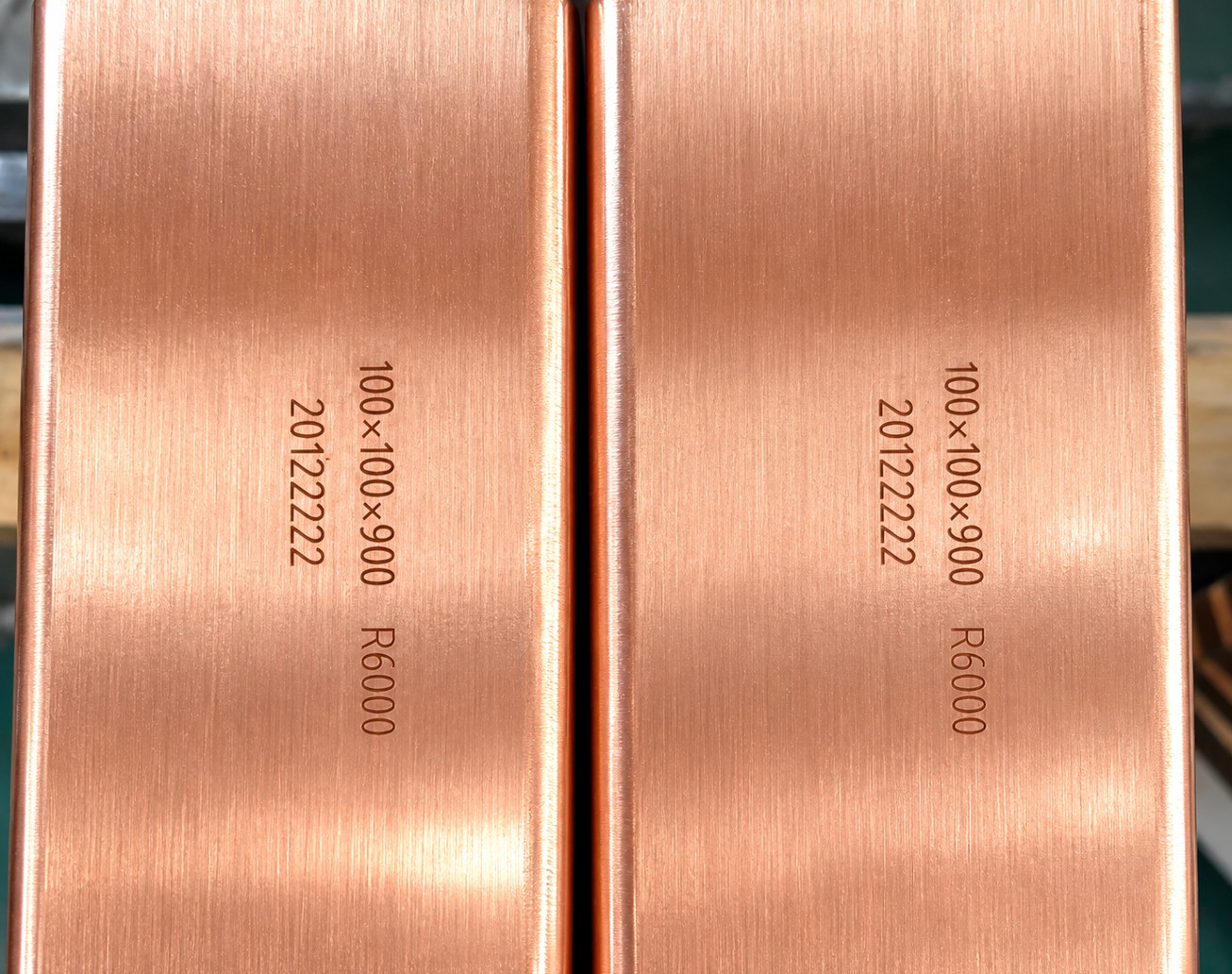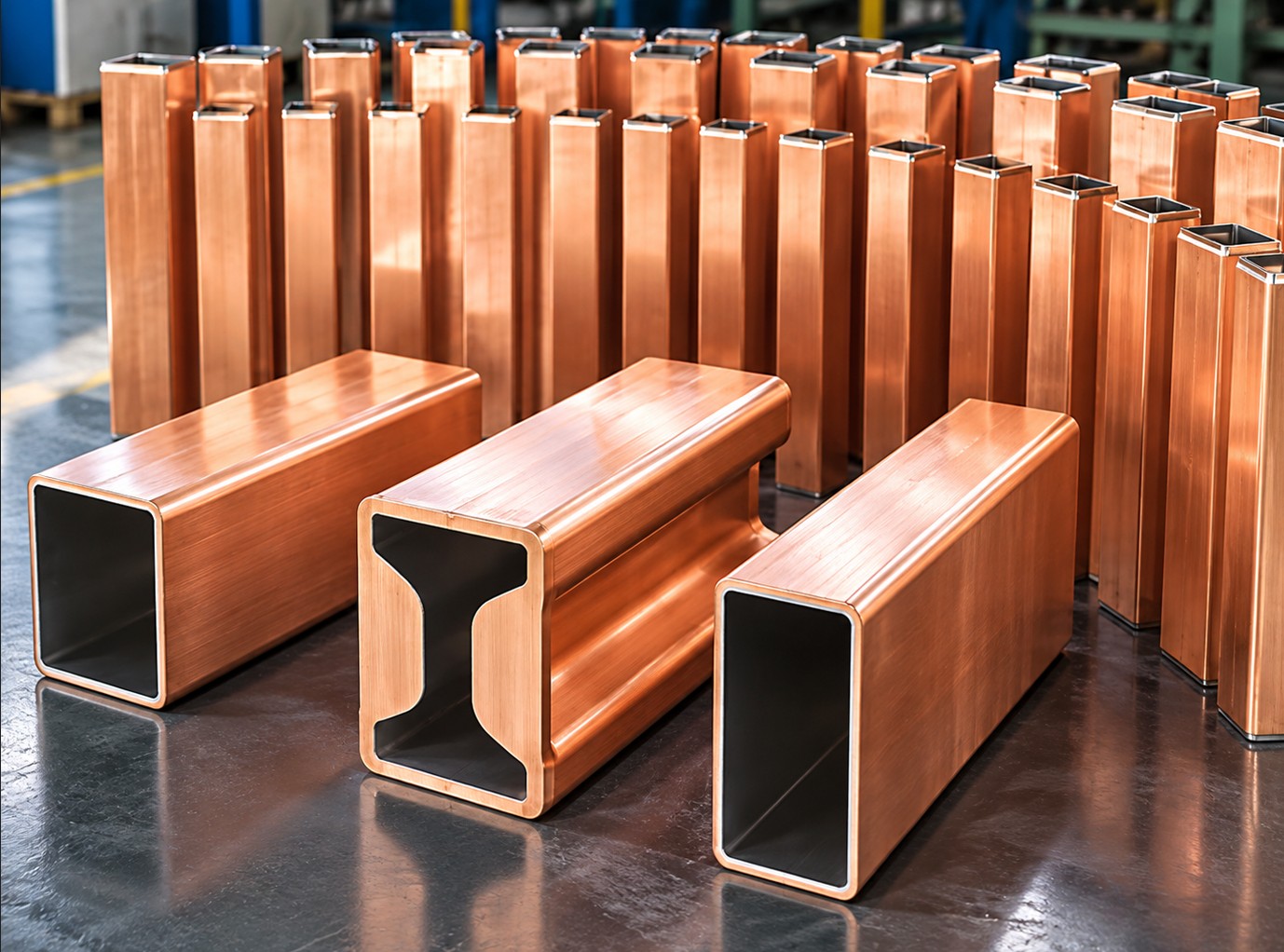

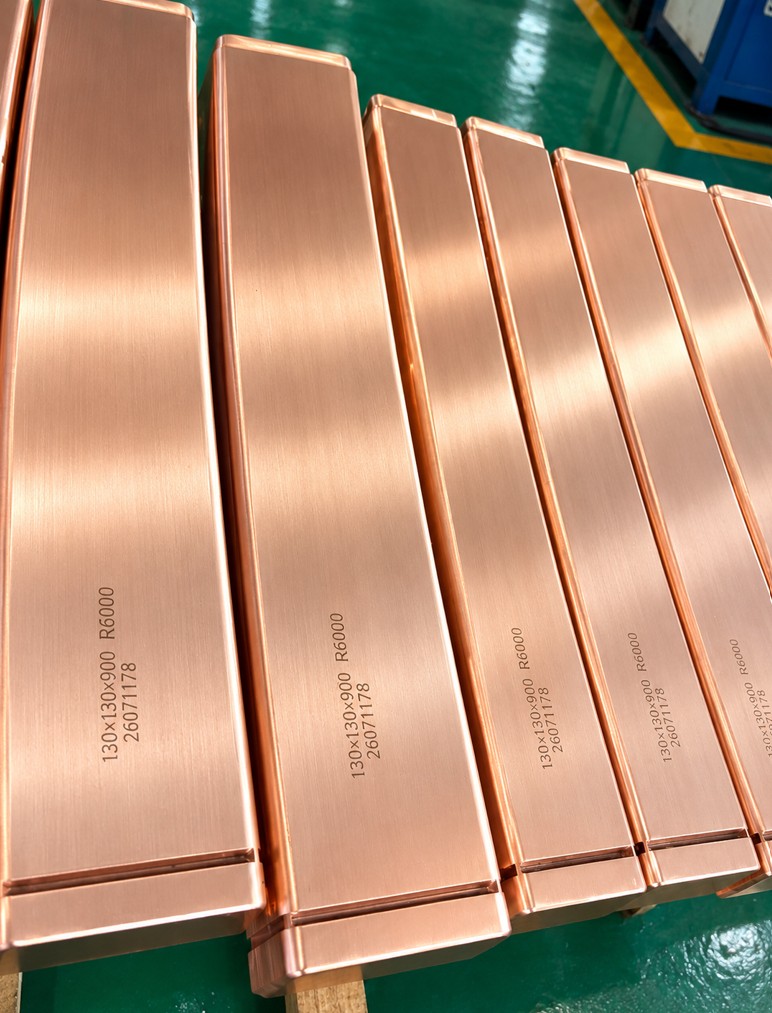
A copper mould tube looks like a simple part: a copper box with a chrome-plated bore. In practice it is the most precisely machined component in the mould section of a continuous casting machine, and a tube that is even slightly wrong for the caster shows up immediately as breakouts, rhomboidity or a short campaign. This guide lists the ten things a buyer has to confirm before asking a copper mould tube supplier for a price.
The section is the billet size at the mould exit, for example 100 × 100, 130 × 130 or 150 × 150 mm. It is the first thing on the tube marking and the first thing on any quotation. Rectangular sections such as 150 × 200 mm and round sections such as Ø150 mm are specified the same way. The full range we produce is in the specification tables.
The casting machine has a fixed radius: R4000, R5000, R6000, R9000 mm or another value. The tube is curved to exactly that radius. This is not a preference; an R6 tube cannot be used on an R9 machine. If you do not know the radius, it is on the machine nameplate, in the OEM manual, or stamped on the old tube (for example "150×150×900 R6000"). See R4, R5, R6 and R9 pages.
Common lengths are 700, 780, 800, 812 (32 in), 900 and 1000 mm. Length is fixed by the water jacket and the mould housing, so measure the old tube or read it off the drawing rather than choosing a "standard".
Typically 8, 10 or 12 mm for billet tubes, thicker for bloom sections. Wall thickness affects heat transfer, stiffness and how many times the tube can be re-machined. We cover the trade-offs in Wall Thickness: 8, 10 or 12 mm?.
Three grades cover almost every billet caster: TP2 / Cu-DHP for standard speed, CuAg0.1 for higher speed and thermal load, CuCrZr for long campaigns and bloom moulds. The grade should follow casting speed and steel grade, not the highest price. See the copper materials page.
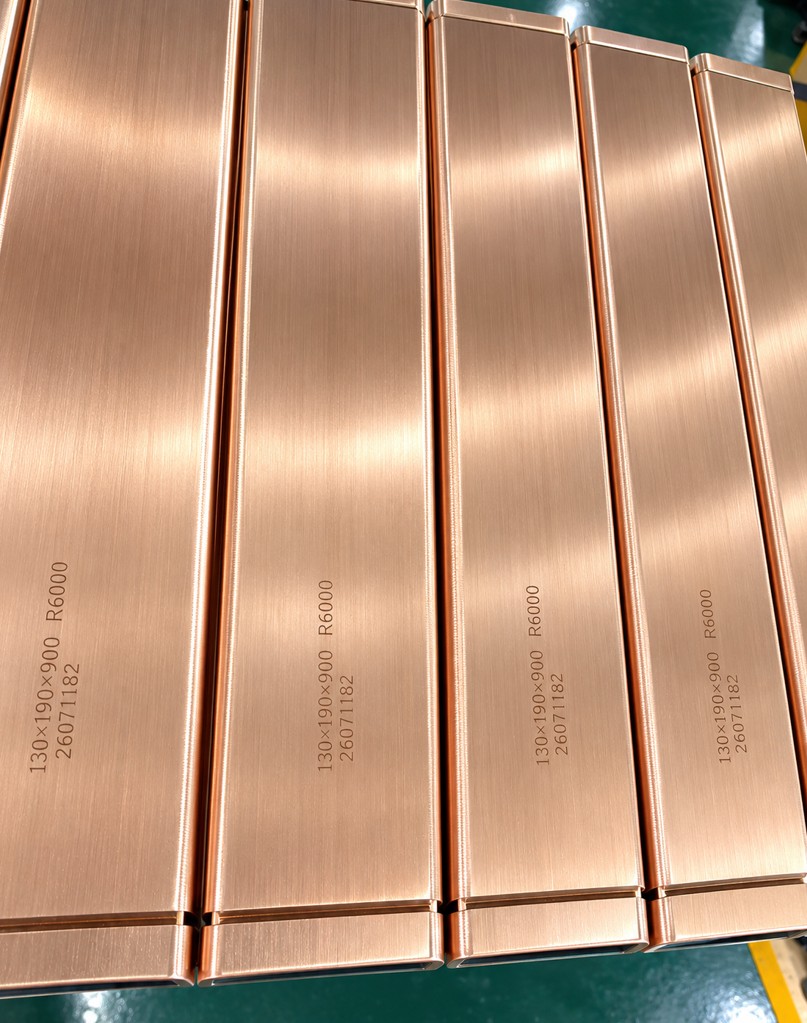
The bore narrows from top to exit so it stays in contact with the shrinking shell. Single, double, multi and parabolic tapers exist; the correct one depends on your casting speed and the OEM design. If you have a drawing, send it. If not, tell us the OEM and the casting speed and we propose a taper.
Hard chrome 0.08–0.12 mm is our standard; thicker layers or nickel-chrome are available. Plating thickness affects wear life and the number of re-plating cycles.
Some tubes have machined water slots, others run in a plain annular gap inside the water jacket. The slot layout must match the jacket. If you are replacing the jacket as well, order them together; see mould water jackets.
Speed decides taper and copper grade. A 130 × 130 tube at 2.2 m/min and the same tube at 3.5 m/min are different products even though the marking is identical.
Peritectic and high-carbon grades put different loads on the tube. Tell your supplier the grades you cast most.
A complete request looks like this: "130 × 130 × 900 mm, R6000, wall 12 mm, CuAg, double taper per OEM drawing, hard chrome 0.10 mm, 20 pcs, casting speed 2.8 m/min, low-carbon and peritectic grades." With this a supplier can quote in one day and manufacture without further questions. Without it, expect a week of back-and-forth. Our ordering checklist has the same list in printable form.
Only if section, radius, length and taper are identical. The radius alone rules out most swaps.
Send photos of both ends, the marking and the measured exit section. We reverse-engineer the taper from the worn tube plus the OEM design.
Standard R6 100/130/150 × 900 tubes: from stock or 2–3 weeks. Other sizes: 4–6 weeks after drawing approval.
Related pages: Copper Mould Tubes · Specification tables · Copper materials · Technical data · Request a quote