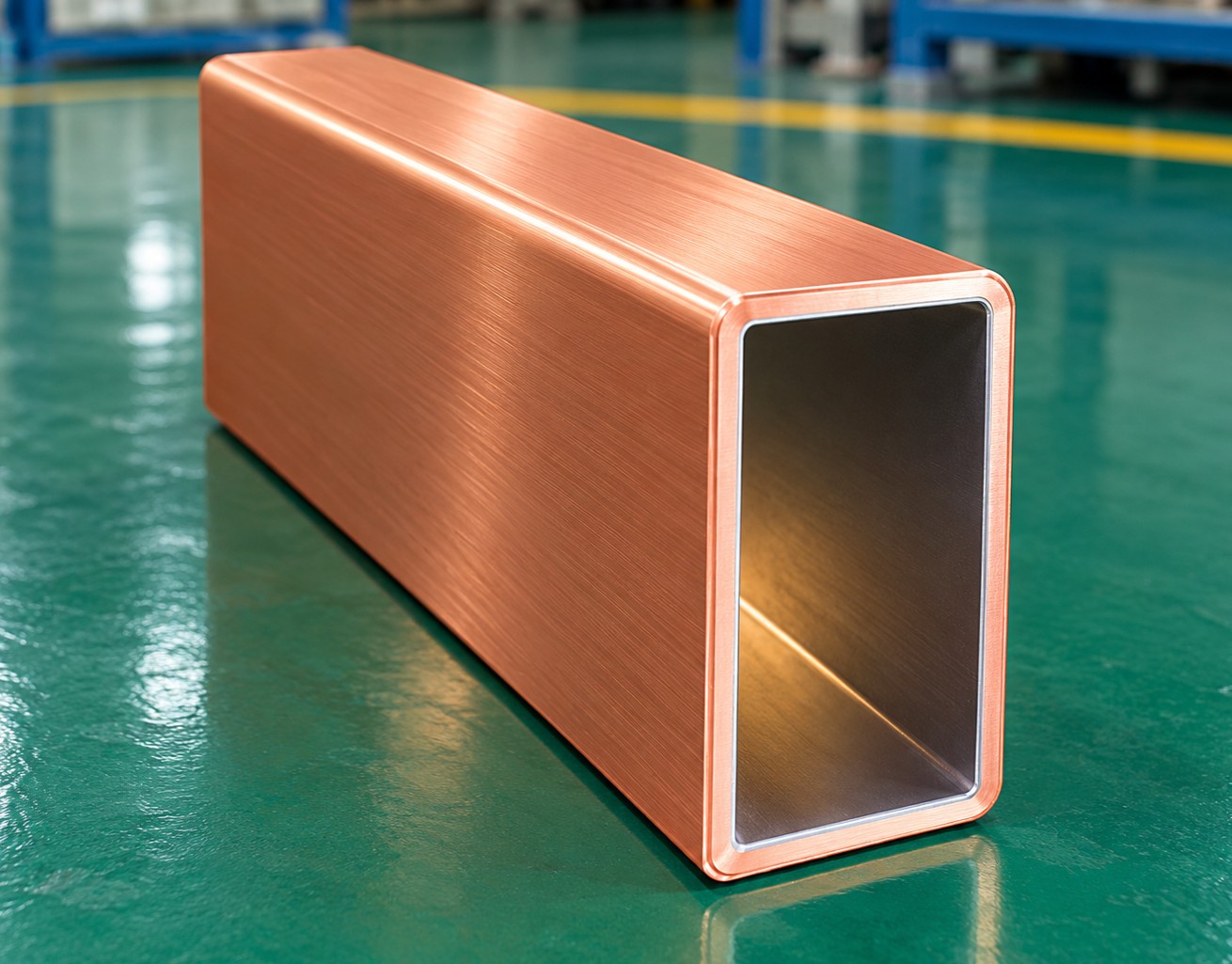

The three copper grades used for continuous casting mould tubes are TP2 / Cu-DHP, CuAg0.1 and CuCrZr. All three are more than 99 % copper and all conduct heat well. The difference is how they behave at the meniscus, where the copper runs at 200–350 °C under thermal cycling: the higher the softening temperature, the longer the tube holds its taper.
| Material | Typical position | Main advantage |
|---|---|---|
| TP2 / Cu-DHP | Standard billet casting | Good thermal conductivity, economical, easy to machine |
| CuAg0.1 | Higher thermal stability | Higher softening / recrystallization resistance |
| CuCrZr | Demanding applications | Higher strength and thermal stability |
Phosphorus-deoxidized copper with 0.015–0.040 % P. Thermal conductivity around 340 W/m·K, softening starts at roughly 250–320 °C. It is the most common billet tube material in the world because for casting speeds up to about 2.5 m/min on small sections it simply works, and it costs the least. Its weakness: at higher meniscus temperatures the copper recrystallizes, the wall softens and the taper opens up, so the tube loses its shape before the chrome wears out.
Adding 0.08–0.12 % silver raises the recrystallization temperature by roughly 80–100 °C without reducing conductivity; CuAg is in fact the best conductor of the three. For casters running 2.5–4 m/min, or casting hot steel grades, CuAg tubes keep their taper markedly longer than Cu-DHP for a modest price premium. This is the grade we recommend most often for 100–150 mm billets at modern speeds.
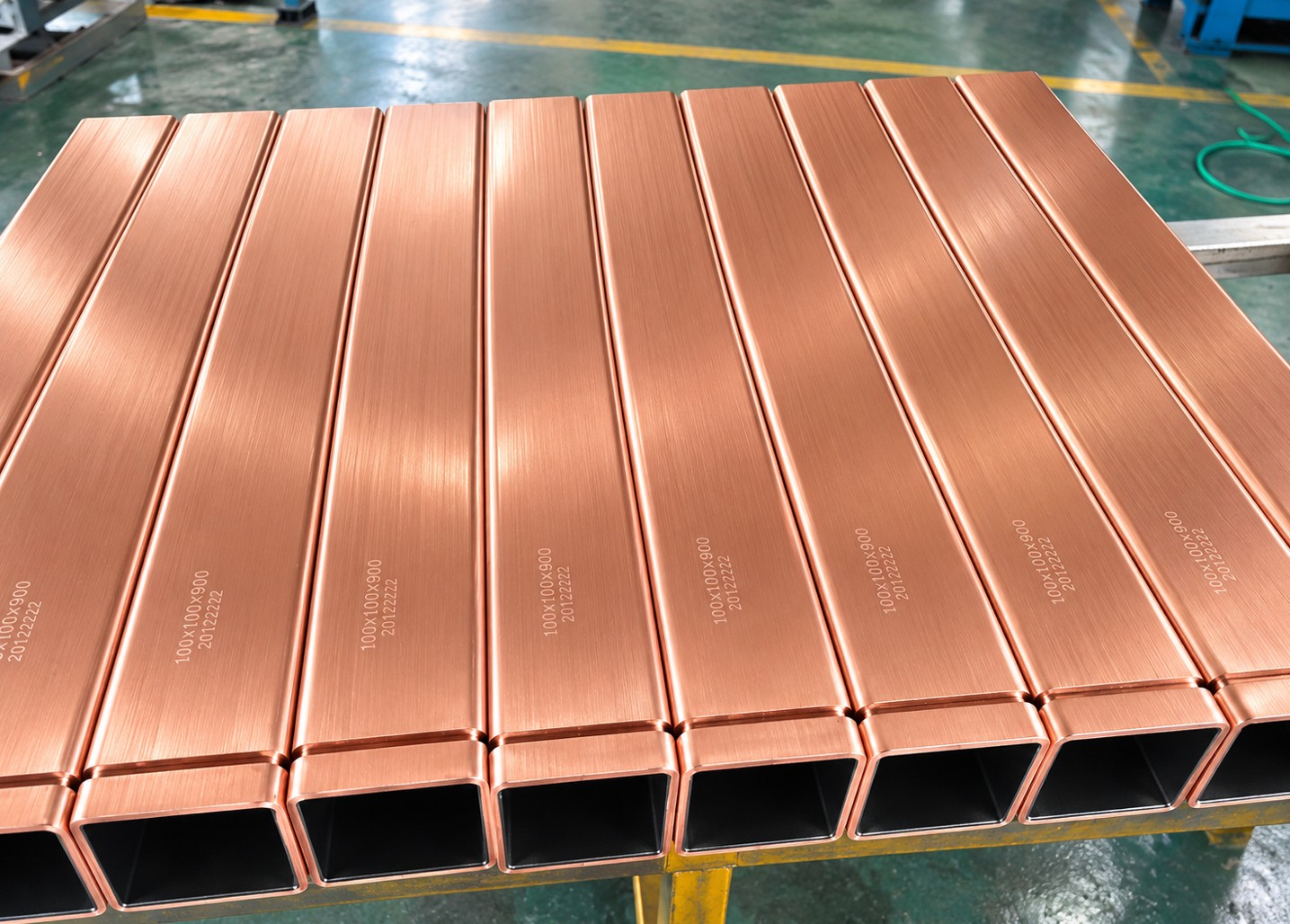
Chromium (0.3–1.2 %) and zirconium (0.03–0.3 %) form precipitates that keep the copper strong up to 450–500 °C. Hardness is 120–160 HB against 80–110 for Cu-DHP, and tensile strength is roughly 50 % higher. Conductivity is slightly lower but still high. CuCrZr is the choice for bloom moulds, mould plates, high-speed casters and any plant that measures mould life in weeks rather than days. It costs more, machines harder and needs a supplier who controls the heat treatment; a poorly aged CuCrZr tube is no better than Cu-DHP.
Do not assume the strongest alloy is always right. On a slow caster with good cooling, CuCrZr gives no measurable life gain over CuAg and costs more. Conversely, using Cu-DHP on a fast caster means replacing tubes for taper loss while the chrome is still intact, which is the most expensive way to run a mould.
Typical property ranges for all three grades are on the technical data page; composition tables are on the copper materials page.
Yes. CuAg0.1, Cu-Ag, silver copper and OFE-Ag all describe copper with about 0.1 % silver.
Yes; many plants run CuAg on the fast strands and Cu-DHP on the slow ones.
Every tube ships with a mill certificate and a spectrometer check of Cu, P, Ag, Cr and Zr.
Related pages: Cu-DHP tubes · CuAg tubes · CuCrZr tubes · Copper materials · Specification tables · Request a quote